

 Blog details


Let’s unlock today some top blog ranking strategies that help to increase visibility.
Just only website to rank higher in search engines isn’t about gaming the system, it’s about creating genuinely valuable content while following proven optimization techniques.
The search landscape has evolved dramatically, and today your content needs to appear not just in traditional search results, but also in AI Overviews, featured snippets, and even be cited by AI chatbots like ChatGPT and Gemini.
Let’s explore the exact blog ranker strategies that actually move the needle in 2026.
Understanding Search Intent: The Foundation of Success
Search intent is the reason behind a user’s query. Are they looking to buy something, learn how to do something, or simply gather information? Google’s algorithms have become incredibly sophisticated at matching content to searcher intent, which means your content must satisfy what users are actually looking for.
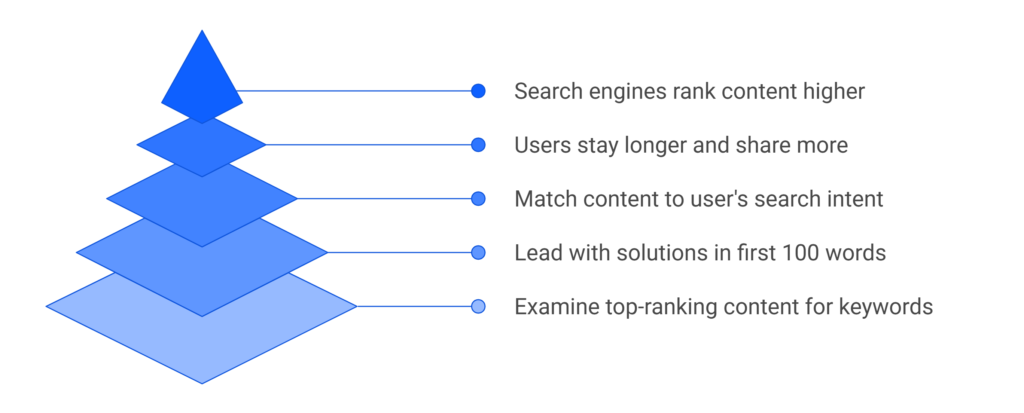
Analyze the SERPs for your target keywords. Search for your primary keyword and examine what’s already ranking. Are the results blog posts, videos, product pages, or something else? This tells you exactly what Google thinks satisfies that query.
Address the specific question immediately. Don’t bury your answer in the tenth paragraph. Lead with the solution in your first 100 words, then provide supporting details. When your content aligns with search intent, users stay longer, share more, and return—all signals that tell search engines your content deserves higher rankings.
Keyword Research: Finding Winnable Opportunities
Targeting the right keywords makes the difference between ranking on page 10 and ranking on page 1. Many bloggers make the mistake of chasing ultra-competitive keywords with millions of searches per month. Instead, focus on strategic keyword selection.
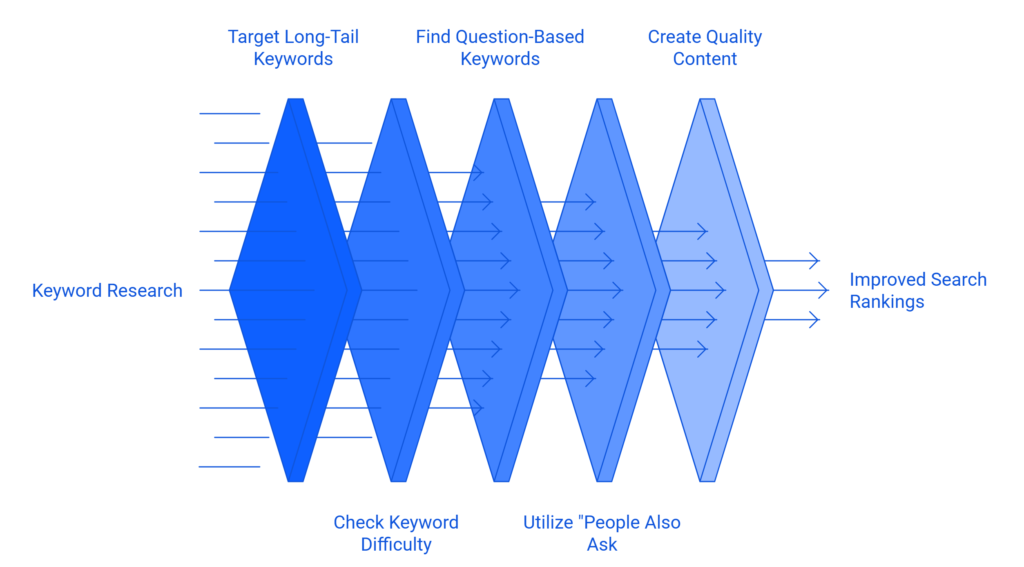
Target long-tail keywords. These are longer, more specific phrases that have lower search volume but higher intent. Instead of “SEO tips,” target “SEO tips for new blogs with no traffic.” These keywords are easier to rank for, more aligned with specific user needs, and more likely to convert.
Look for keyword difficulty scores below 30. Most keyword research tools provide a difficulty score. Keywords with scores under 30 are generally easier to rank for, especially for newer blogs.
Find question-based keywords. Queries that start with “how to,” “what is,” “why does,” and “when should” are perfect for blog content. They signal clear search intent and often trigger featured snippets.
Use the “People Also Ask” section. This Google feature shows related questions people are searching for. These are gold mines for secondary keywords and content ideas that can help you rank for multiple related terms with a single comprehensive post.
Tools like Google Keyword Planner, Semrush, Ahrefs, or Ubersuggest can help you find these opportunities. Remember: a keyword with 500 searches per month that you can rank for is infinitely more valuable than one with 50,000 searches that you can’t.
Creating Quality Content That Stands Out
Search engines have gotten remarkably good at identifying quality content by analyzing how users interact with your pages. Here’s how to create content that both users and search engines love:
Lead with the answer immediately. Put your main point at the top, then elaborate below. This approach satisfies user intent quickly and reduces bounce rates—a critical ranking signal.
Write in short, digestible chunks. Break your content into short paragraphs of 2-3 sentences maximum, use clear subheadings every 200-300 words, incorporate bullet points for lists, and add strategic white space for visual breathing room.
Add genuine value beyond what’s already ranking. Before writing, research the top 10 results for your target keyword. Then ask: “How can I make this better?” Include original research or data, add expert quotes, provide more actionable steps, create better visuals, or cover aspects competitors missed.
Use real examples and case studies. Generic advice is forgettable. Specific examples, screenshots, and real-world applications make your content memorable and shareable. Show, don’t just tell.
Include visuals that add value. Skip generic stock photos. Instead, use screenshots showing exactly what you’re explaining, custom graphics that simplify complex concepts, charts supporting your points, step-by-step visual guides with annotations, and before/after comparisons demonstrating results.
On-Page SEO: The Technical Foundation
Once you have quality content, optimize it properly. These on-page SEO elements help search engines understand and rank your content.
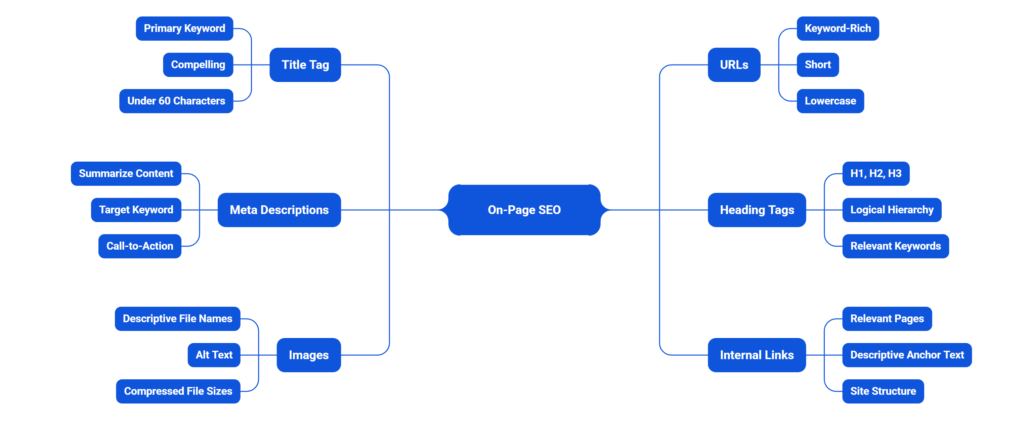
Optimize your title tag. This is one of the strongest ranking signals. Your title should include your primary keyword (preferably near the beginning), be compelling and clickable to improve CTR, stay under 60 characters, accurately reflect your content, and use power words that create curiosity.
Write descriptive URLs. Use clean, keyword-rich URLs. Good example: /blog-ranking-strategies-increase-traffic/. Bad example: /p=12345. Keep URLs short, descriptive, free of special characters, lowercase only, and separated by hyphens.
Craft compelling meta descriptions. While not a direct ranking factor, meta descriptions significantly affect click-through rates. Summarize your content in 150-160 characters, include your target keyword naturally, create curiosity or promise specific value, and include a call-to-action when appropriate.
Use heading tags strategically. Structure your content with H1, H2, and H3 tags that create a logical hierarchy, include relevant keywords naturally, help readers and search engines understand your structure, and describe what’s actually in the following section.
Optimize images properly. Every image should have descriptive file names (blog-ranking-tips.jpg not IMG_1234.jpg), alt text describing the image with keywords when relevant, compressed file sizes for faster loading, and appropriate dimensions.
Add internal links throughout your content. Link to other relevant pages on your site using descriptive anchor text. This helps users discover more content, helps search engines understand your site structure, distributes ranking power across pages, and increases time on site while reducing bounce rates.
Building Topical Authority
Search engines favor sites that demonstrate expertise in specific topics. This topical authority is built over time through strategic content creation.
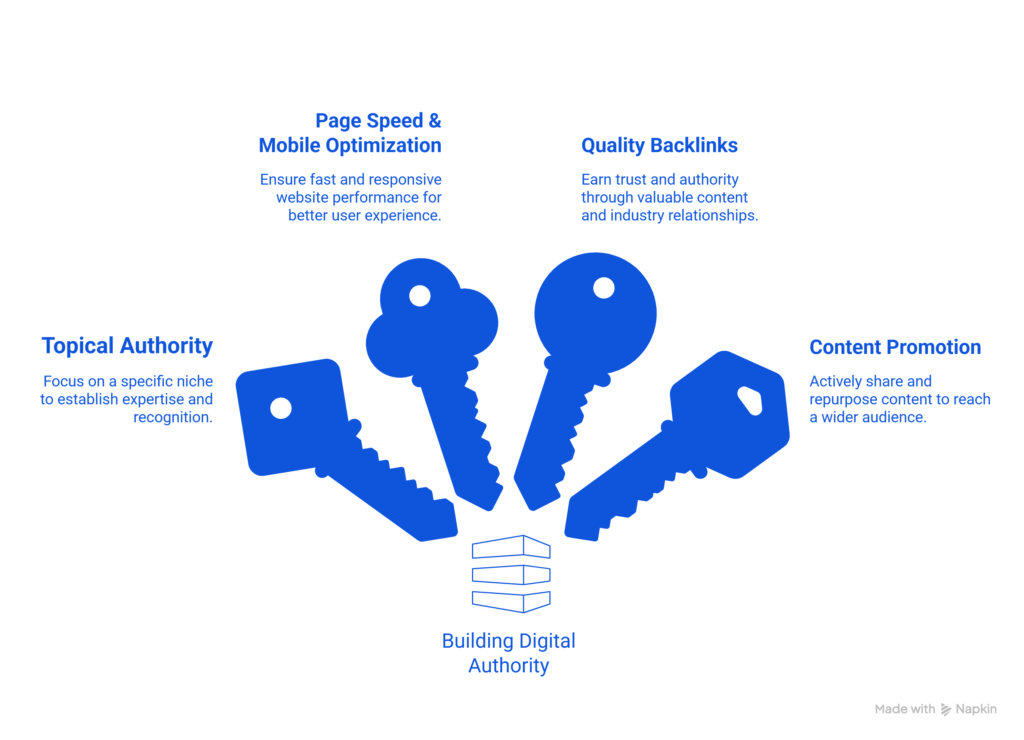
Focus on a specific niche. Rather than writing about everything, concentrate on a particular topic area. This allows you to go deeper on subjects, build genuine expertise, create comprehensive resources, and earn recognition as an authority.
Create topic clusters. This powerful strategy involves creating a comprehensive pillar page covering a broad topic (2,000-5,000 words), writing multiple cluster posts covering specific subtopics (1,000-2,000 words each), and linking all related content together strategically.
For example, a pillar page might be “Complete Guide to Content Marketing” with cluster posts covering email marketing strategies, social media content planning, SEO copywriting techniques, video marketing best practices, and content distribution methods.
Demonstrate E-E-A-T (Experience, Expertise, Authoritativeness, Trustworthiness). Google evaluates content quality based on these factors. Share firsthand experiences and real results, demonstrate deep knowledge of your subject, build recognition through mentions and citations, and be accurate by citing sources and maintaining transparency.
Page Speed and Mobile Optimization
Slow pages frustrate users and hurt rankings. Search engines prioritize fast, accessible content because it provides better user experience.
Check your site speed regularly using Google’s PageSpeed Insights. Aim for Largest Contentful Paint (LCP) under 2.5 seconds, First Input Delay (FID) under 100 milliseconds, and Cumulative Layout Shift (CLS) under 0.1.
Optimize images for faster loading. Compress images before uploading (aim for under 100KB each), use modern formats like WebP, implement lazy loading so images load only when needed, and use responsive images for different screen sizes.
Ensure mobile responsiveness. Over 60% of searches happen on mobile devices. Your site must load quickly on mobile networks (target under 3 seconds), display properly on various screen sizes, have easily tappable buttons and links (minimum 48×48 pixels), and use readable font sizes (at least 16px for body text).
Building Quality Backlinks
Backlinks remain one of the most important ranking factors. They signal to search engines that other sites trust and vouch for your content. Focus on earning quality links naturally through valuable content.
Create link-worthy content. The best link-building strategy is creating content people naturally want to reference: original research and data, comprehensive guides, unique frameworks or methodologies, case studies with real results, interactive tools or calculators, and expert roundups.
Guest post on relevant sites. Contributing valuable content to established sites in your niche can earn quality backlinks. Focus on sites with genuine audiences in your niche, publications that maintain editorial standards, and opportunities to share genuine expertise.
Build relationships in your industry. Connect with other bloggers, journalists, and content creators. Comment thoughtfully on their blog posts, share their content on social media, mention them in your content when relevant, and collaborate on projects. Genuine relationships often lead to natural linking opportunities.
Leverage broken link building. Find broken links on relevant websites, reach out to site owners to inform them, suggest your relevant content as a replacement, and make it easy by providing exact anchor text and URL.
Remember: one high-quality link from an authoritative site is worth more than dozens of low-quality links from spammy directories.
Content Promotion Strategies
Creating great content is only half the battle. You need to actively promote it to gain initial traction and signals that boost rankings.
Share on social media strategically. Don’t just post links—create engaging posts that highlight key insights, ask questions to spark discussion, use relevant hashtags, tag people mentioned in your content, and post at optimal times when your audience is most active.
Engage in relevant online communities. Platforms like Reddit, Quora, industry forums, and LinkedIn groups can drive targeted traffic when you provide genuine value in your responses, answer questions thoroughly, include your content as supporting reference when truly relevant, and build reputation through consistent helpful participation.
Repurpose content into different formats. Turn blog posts into YouTube videos, create social media carousels with key points, record podcast episodes discussing concepts, design infographics highlighting main takeaways, and develop slide decks for SlideShare. Each format reaches different audience segments and provides additional opportunities for links and mentions.
Monitoring Performance and Continuous Improvement
Blog ranking strategies aren’t “set it and forget it.” You need to track performance and continuously refine your approach based on data.
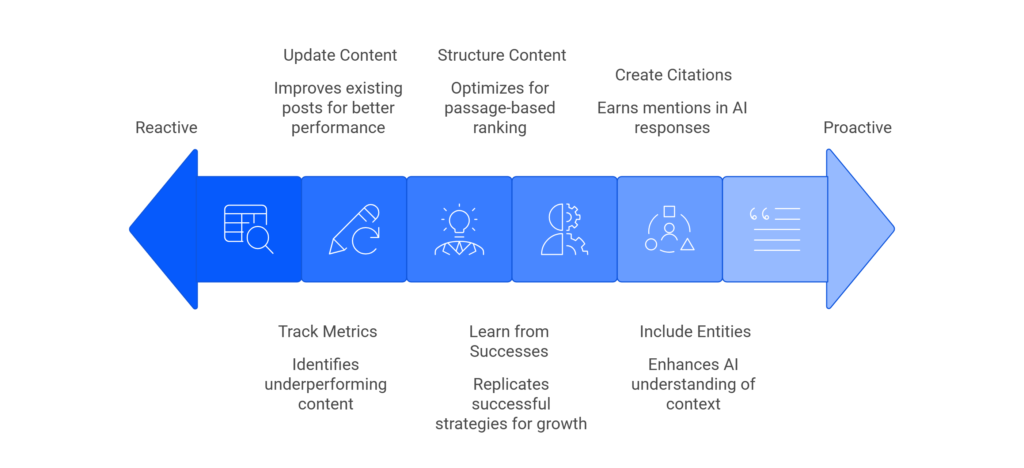
Track key metrics regularly: organic traffic trends, keyword rankings for target terms, click-through rates from search results, time on page and engagement metrics, conversion rates from organic traffic, and bounce rates to identify content that isn’t meeting expectations.
Identify underperforming content. Use Google Search Console and analytics tools to find posts that rank on page 2 (positions 11-20) and are close to breakthrough, have high impressions but low clicks (need better titles/descriptions), or have high bounce rates (content doesn’t match intent).
Update and optimize existing posts. Rather than always creating new content, improve what you already have. When updating content, refresh publication dates only if you’ve made substantial improvements, add new sections addressing recent developments, update statistics and examples, improve internal linking to newer related content, and enhance formatting and readability.
Learn from your successes. When a post performs exceptionally well, analyze what made it successful, identify patterns you can replicate, create more content on related topics, and build topic clusters around successful themes.
Avoiding Common Mistakes
Many bloggers sabotage their own success by following outdated or harmful practices.
Don’t stuff keywords. Use keywords naturally where they fit, include semantic variations and related terms, and focus on comprehensiveness over keyword density.
Avoid thin content. Posts with only 300-400 words rarely provide enough value to rank well for competitive topics. Match or exceed the depth of top-ranking content and cover topics comprehensively.
Don’t ignore mobile users. Test your site on actual mobile devices regularly, ensure buttons and links are easily tappable, make sure text is readable without zooming, and check loading speed on slower mobile connections.
Skip black hat tactics. Avoid buying links, using private blog networks, keyword stuffing, cloaking or deceptive redirects, automated content generation without human review, and scraping or spinning other sites’ content.
Creating Content for AI-Powered Search
The search landscape now includes AI Overviews, chatbots, and generative search experiences. Your content needs to work in these contexts too.
Structure content for passage-based ranking. AI systems often extract specific paragraphs rather than entire pages. Make each section self-contained and complete, lead with clear definitive answers, use descriptive headings that summarize section content, and ensure paragraphs make sense when read in isolation.
Include entities and related concepts. When writing about “email marketing,” naturally mention conversion rates, A/B testing methodologies, email automation and segmentation, lead nurturing strategies, and specific tools like Mailchimp or ConvertKit. This helps AI systems understand the full context.
Create content worth citing. Earn mentions in AI-generated responses by publishing original research with unique data, sharing unique insights or frameworks, providing expert perspectives backed by experience, using concrete examples and case studies, and backing claims with credible data and sources.
Quick Action Tips for Immediate Implementation
Content Creation: Write headlines first, answer main questions in the first 100 words, use target keywords in opening paragraphs naturally, include original insights or data points, add compelling meta descriptions, and end with clear calls-to-action.
Technical Optimization: Compress all images before uploading, use descriptive file names, add alt text to every image, create custom URL slugs with keywords, ensure HTTPS security, install XML sitemaps, submit sitemaps to Google Search Console, and fix crawl errors immediately.
User Experience: Keep paragraphs to 2-3 sentences, use subheadings every 200-300 words, include relevant screenshots, add white space between sections, make font size at least 16px, test on multiple mobile devices, and avoid intrusive pop-ups.
Promotion: Share posts on social media within the first hour, email subscriber lists within 24 hours, engage in relevant forums, reach out to mentioned individuals, repurpose key points throughout the week, and use paid promotion for best content.
Maintenance: Review and update posts every 6-12 months, fix broken links quarterly, monitor Search Console for errors weekly, check page speed monthly, analyze top-performing content, optimize page 2 rankings, and track keyword rankings consistently.
Essential Resources and Tools
Official Resources: Google Search Central Documentation, Google’s SEO Starter Guide, Core Web Vitals Documentation, and Google Search Console Help provide authoritative guidance directly from Google.
Keyword Research Tools: Google Keyword Planner (free), Semrush, Ahrefs, Ubersuggest, AnswerThePublic, and Google Trends help identify opportunities.
Technical SEO Tools: Google Search Console (free), PageSpeed Insights (free), Screaming Frog SEO Spider, and GTmetrix provide comprehensive auditing capabilities.
Content Optimization: Hemingway Editor, Grammarly, Yoast SEO, Rank Math, Surfer SEO, and Clearscope help improve content quality and optimization.
Analytics: Google Analytics 4, Google Search Console, Semrush, Ahrefs, and Hotjar track performance and user behavior.
The Path to Sustainable Success
Blog ranking success comes from consistently applying these proven strategies while adapting to your specific niche and audience. The search landscape has transformed into an intelligent, AI-powered ecosystem that rewards genuine value and punishes manipulation.
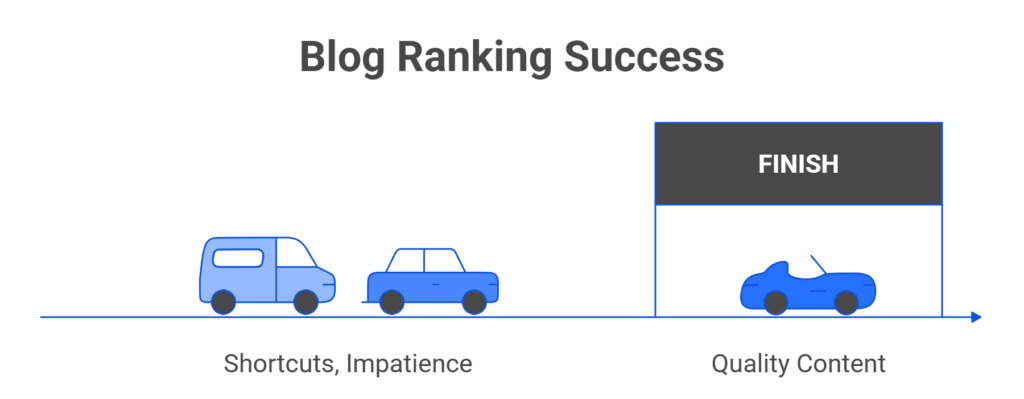
Quality always wins in the long run. You might see competitors cutting corners, but these shortcuts are unsustainable. Google’s algorithms get smarter every day. Quality content you create today will continue driving traffic for years to come.
Be patient with your progress. New content typically takes 3-6 months to reach ranking potential. Your first 10 posts might get minimal traffic, but somewhere between month 6 and 12, things start clicking. Traffic begins growing, rankings improve, and authority builds upon itself.
Focus on compound growth. Each quality post builds on previous success. Post #1 might get 50 visitors per month, post #10 might get 200 because your site has more authority, and post #50 might get 1,000 because you’ve built topical authority. New content ranks faster as your site authority grows.
The human element cannot be replaced. As AI tools become more prevalent, your unique experiences, insights, and perspectives become more valuable. AI can help you optimize and scale, but it cannot replace the authentic voice that comes from genuine expertise and passion for your topic.
Remember that rankings are means to an end. What matters most is the impact you create: helping people solve real problems, building a loyal audience that trusts your expertise, and creating something you’re genuinely proud of. Traffic is vanity, but helping people is purpose.
Your Action Plan
Start with one strategy from this guide. Master it. Then add another. Build momentum through small, consistent wins. Here’s your roadmap:
This week: Choose your first 5 target keywords using the research strategies outlined above.
This month: Create and publish your first optimized blog post following these guidelines.
Months 2-3: Publish consistently (at least 2-4 posts per month) while refining your process.
Months 4-6: Start updating and optimizing existing content based on performance data.
Months 7-12: Build on momentum with topic clusters, promotion, and relationship building.
Your audience is out there searching for exactly what you have to offer. These blog ranking strategies are the bridge that connects your value to the people who need it. When you focus on creating genuine value and apply these proven optimization techniques, you make it easier for your ideal audience to find you.
The gap between where you are now and where you want to be is filled with consistent action. Not perfect action. Just persistent, earnest effort to create something valuable and help it reach the right people.
The blog post that changes everything for you might be the next one you write. Start today.